
You’ve watched cracks spread every winter. Water pools near your foundation after storms. Those small problems turn into safety hazards and expensive repairs faster than most homeowners expect.
Here’s what changes when your driveway is installed correctly. Water drains away from your foundation instead of pooling. Individual pavers flex with ground movement instead of cracking into pieces. You stop budgeting for resurfacing every few years.
Long Island’s freeze-thaw cycles destroy poorly installed driveways. Water seeps into cracks, freezes, expands, and creates bigger damage with every cold snap. Proper base preparation and material selection eliminate that cycle entirely. You’re looking at 25 to 75 years of performance with minimal maintenance when the foundation work is done right.
We’ve been serving Suffolk County and Nassau County homeowners for over 15 years. Every job includes an owner on-site, not a rotating crew you’ve never met.
You’re working with licensed, insured contractors who understand Long Island’s soil conditions, drainage patterns, and building codes. We’ve seen what happens when driveways are installed without proper base preparation. We’ve repaired the damage from contractors who skip critical steps.
North Bay Shore homeowners deal with specific challenges – proximity to water, soil composition, and weather patterns that demand proper installation techniques. You need contractors who’ve worked in this area long enough to know what holds up and what fails in three years.
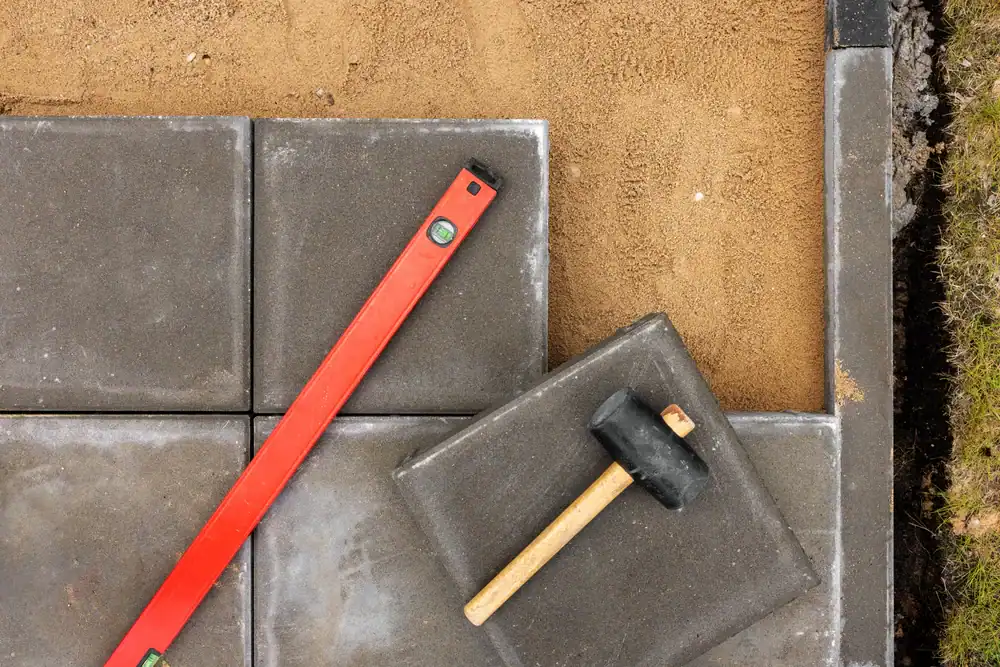
Proper driveway installation starts below the surface. We excavate at least 12 inches down, removing unstable soil and old materials. Geotextile fabric goes down first to prevent base materials from mixing with subsoil over time.
The base layer uses 6 to 8 inches of crushed stone, compacted in lifts with heavy equipment. This isn’t optional. This layer determines whether your driveway lasts five years or fifty. We add 1 to 2 inches of leveling sand, screeded perfectly flat before any surface material goes down.
Grading directs water away from your foundation and toward proper drainage points. Paver joints allow water to percolate through instead of running off and pooling. Edge restraints – concrete or metal – lock everything in place invisibly. You see the finished surface. The real work happens in those first 12 inches.
Ready to get started?
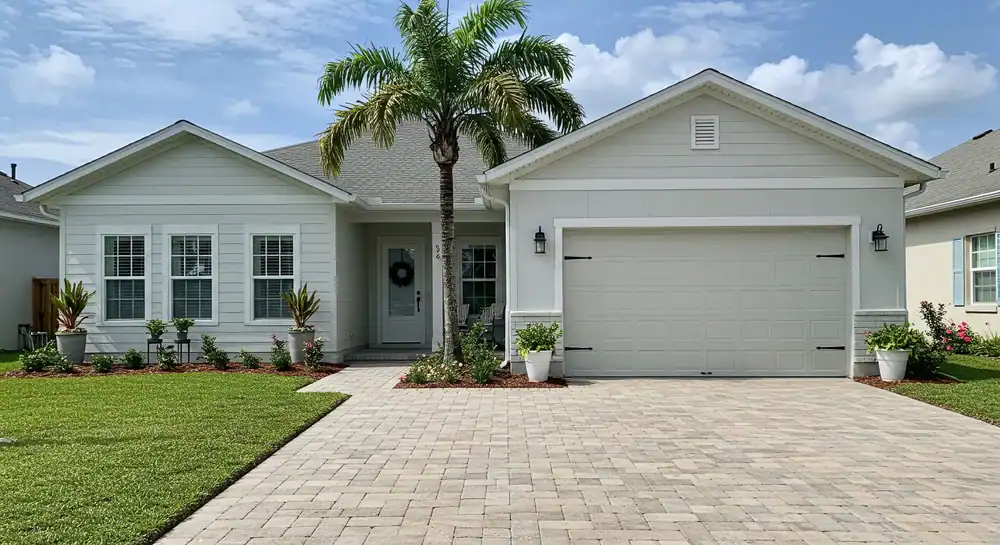
Brick pavers run $18 to $23 per square foot in North Bay Shore. That’s higher than asphalt’s $7 to $15 range, but asphalt needs resealing every three to five years. Pavers last 25 to 75 years with almost no maintenance.
Concrete driveway installation in Suffolk County costs $7 to $13 per square foot for standard applications. Concrete cracks in Long Island’s climate, but it’s more affordable upfront if you’re working within a tight budget. We’ll walk you through the actual long-term costs so you can decide what makes sense.
Permeable pavers are gaining traction here because they handle drainage naturally and meet environmental requirements some properties face. Cobblestone driveway aprons and Belgian block borders add visual interest without compromising function. The best time to install is late spring through early fall when temperatures stay between 65 and 75 degrees consistently.
Water pooling anywhere on your driveway or near your foundation after rain means you have drainage problems. Most homeowners don’t notice until damage becomes visible – cracks spreading, pavers sinking, or water seeping into basements during storms.
Poor drainage destroys driveways from underneath. Water saturates the base layer, weakens soil stability, and creates voids where materials settle unevenly. In winter, that trapped water freezes and expands, accelerating surface damage.
Proper grading slopes your driveway away from structures at a minimum 2% grade. We evaluate your property’s natural drainage patterns, soil composition, and water flow during heavy rain. Sometimes the fix is regrading during installation. Other properties need French drains or catch basins integrated into the design.
Repairs make sense when cracks are isolated and your base layer is still stable. We’re talking hairline cracks or small sections that haven’t shifted. Patching buys you a few more years if the underlying structure is sound.
Replacement becomes necessary when cracks are widespread, sections have sunk or heaved, or water damage has compromised the base. You can patch surface cracks, but if the foundation is failing, those repairs won’t hold. You’re spending money on fixes that fail within a year or two.
Here’s the honest assessment: if more than 30% of your driveway shows damage, or if you’re seeing repeated failures in repaired areas, replacement costs less long-term than ongoing repairs. We’ll look at your specific situation and tell you which approach actually makes financial sense.
Plan on five to seven days for a standard two-car driveway, weather permitting. Day one is excavation and base preparation. Days two and three involve base material installation and compaction. Day four covers leveling and edge work. Day five is concrete pour and finishing.
You can’t use the driveway for at least seven days after concrete is poured. Full cure time is 28 days, though you can drive on it carefully after the first week. Rushing this process creates weak spots that fail prematurely.
Paver installations take slightly longer – usually seven to ten days – because each unit is placed individually. The advantage is you can use the driveway immediately after installation. No waiting for concrete to cure. Weather delays happen. Rain stops concrete pours entirely and slows base compaction work.
Upfront, yes. Pavers cost $18 to $23 per square foot installed versus $7 to $15 for asphalt. For a standard 24-by-40-foot driveway, you’re looking at roughly $17,000 to $22,000 for pavers compared to $6,700 to $14,400 for asphalt.
Here’s what changes that calculation. Asphalt needs resealing every three to five years at $500 to $1,000 per application. Cracks need filling. Surface deterioration requires patching. Over 20 years, you’ll reseal four to six times and likely need one full overlay or replacement.
Pavers need almost nothing. Sweep them occasionally. Maybe replace one or two damaged units over decades. Individual pavers move independently with ground shifts, so you don’t get the large-scale cracking that destroys solid surfaces. Total maintenance over 20 years runs a few hundred dollars maximum. The math shifts significantly when you calculate actual cost per year of use.
Soil erosion under your driveway creates voids where materials settle. Water is usually the culprit – it washes away soil particles gradually, especially in areas with poor drainage or high water tables. North Bay Shore’s proximity to water makes this particularly common.
Inadequate base preparation during original installation causes most sinking issues. If the base layer wasn’t thick enough, properly compacted, or installed over unstable soil, settling happens within a few years. Tree roots growing under driveways also displace soil and create uneven surfaces.
Fixing sunken sections requires excavating the affected area, addressing the underlying cause – improving drainage, removing roots, stabilizing soil – and rebuilding the base properly. Surface patches don’t work because they don’t address why the sinking happened. You need to fix the foundation problem or the same section will sink again.
Most driveway replacements in Nassau County require building permits, especially if you’re changing the footprint, adding drainage structures, or working near property lines. Requirements vary by township, but expect permit costs between $100 and $500 depending on project scope.
We handle permit applications as part of our service because we know local code requirements and inspection processes. DIY permit applications often get rejected for missing technical details or incorrect specifications.
Inspections typically happen after base preparation and before final surface installation. Inspectors verify proper depth, base materials, compaction, and drainage grading. Skipping permits seems like a cost savings until you try to sell your property and discover unpermitted work complicates title transfers or requires expensive corrections.
Other Services we provide in North Bay Shore