


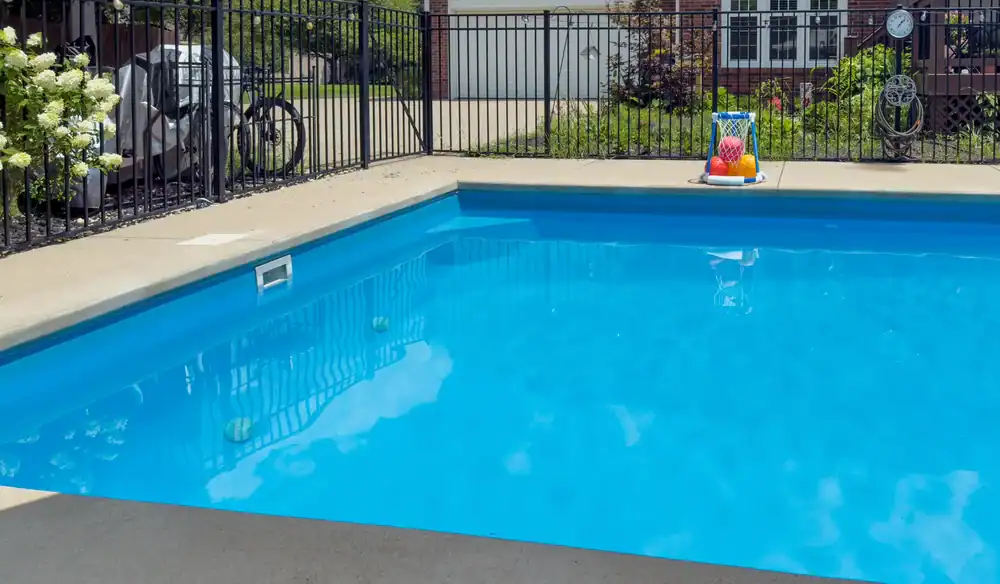
You’re not buying a cookie-cutter hole in the ground. You’re getting a pool designed around your yard’s drainage, your soil type, and how you actually want to use the space.
North Lindenhurst sits in an area where soil conditions shift from sandy to clay-heavy depending on which street you’re on. That means the pool that works two blocks over might need a completely different foundation approach on your property. We account for that before we dig.
The end result is a pool that doesn’t crack after the first winter, doesn’t flood your basement when it rains, and doesn’t require you to become a part-time engineer just to keep it running. You get something that works with your property, not against it.
We’ve been working in Nassau and Suffolk Counties long enough to know which permits take two weeks and which ones take six. We know the soil. We know the inspectors. We know what breaks during a Long Island winter and how to prevent it.
Our background in masonry work means we’re not just pool installers—we handle the hardscaping, the grading, the retaining walls, and the concrete work that turns a basic pool into a complete backyard. One crew. One timeline. No waiting on three different contractors to show up.
You’re working with people who’ve done this in your area, not a franchise learning as they go.
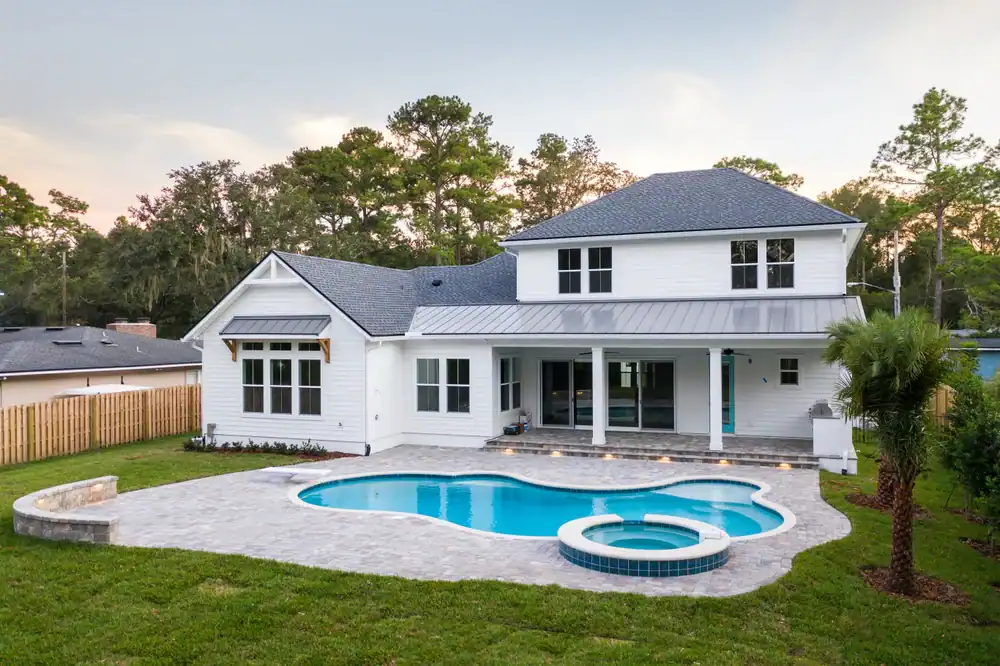
First, we walk your property and talk through what you’re picturing. We’re looking at drainage, setbacks, utility lines, and how your yard slopes. That tells us what’s possible and what’s going to cause problems down the road.
Then we handle the permits. In Suffolk County, that means building permits, electrical, plumbing, and sometimes health department sign-offs depending on your septic setup. We submit everything, track it, and handle any revisions. You don’t sit on hold with the town.
Once permits clear, excavation starts. Depending on your soil, that’s anywhere from one day to three. Then we’re into forming, plumbing, electrical rough-ins, and the shell itself—gunite, fiberglass, or vinyl depending on what we spec’d for your site. After the shell cures, we’re into coping, tile, decking, and any masonry work around the pool. Typical timeline from breaking ground to filling the pool is six to eight weeks if weather cooperates.
Ready to get started?
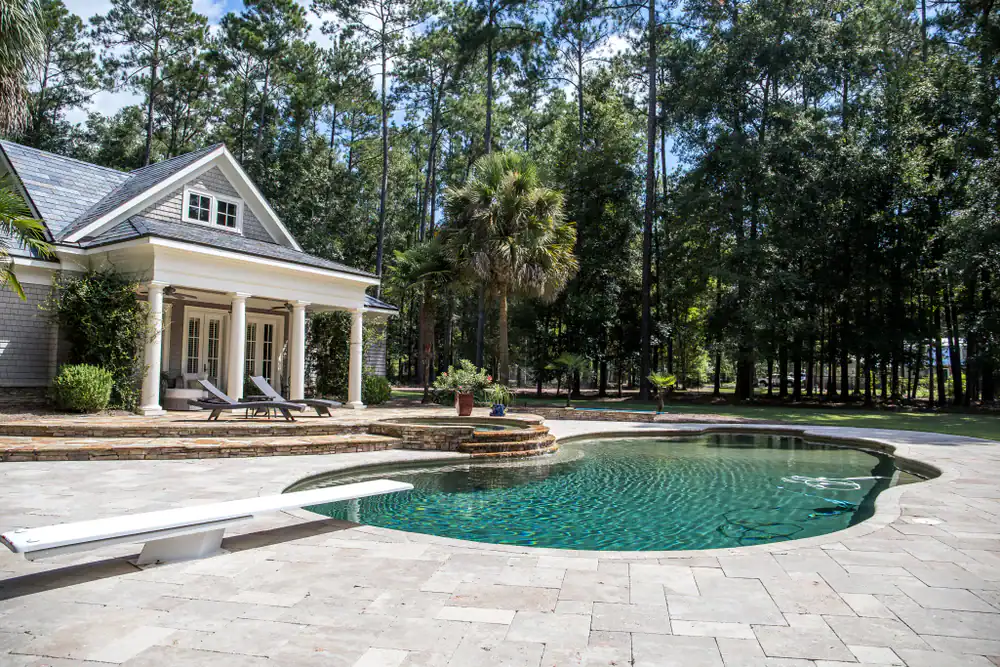
You’re getting the pool, but you’re also getting everything that makes it usable. That means custom pool coping and tile in Suffolk County that can handle freeze-thaw cycles without cracking. It means concrete pool surrounds in Suffolk County that slope correctly so water drains away from your house, not toward it.
If your yard has elevation changes, we’re building pool retaining walls and grading that keep everything stable. If you want the space to feel finished, we’re doing pool patio masonry in Suffolk County—pavers, stone, whatever fits the look you’re going for.
North Lindenhurst properties often need more grading work than other parts of Long Island because of how the water table sits. We handle that during excavation so you’re not dealing with a swampy yard every time it rains. The goal is a complete backyard poolscape in Suffolk County that doesn’t need a phase two the following year because something was missed.
Plan on two to three weeks if everything’s submitted correctly the first time. Suffolk County requires a building permit, electrical permit, and plumbing permit at minimum. If you’re on septic, the health department gets involved and that can add time.
The bigger issue isn’t the timeline—it’s knowing what the town wants to see in the application. Setback requirements, fence specs, drainage plans—if any of that’s wrong or missing, you’re starting over. We’ve submitted enough of these to know what clears and what gets kicked back.
You’ll also need a survey if you don’t have a recent one. The town wants to see exactly where the pool sits in relation to property lines and easements. That’s on you to provide, but we’ll tell you exactly what the surveyor needs to mark.
Soil and water table. The South Shore has sandy soil and high groundwater, which means you’re often dealing with dewatering during excavation. The North Shore has more clay and rock, which means harder digging but better drainage.
North Lindenhurst falls somewhere in the middle. You’ve got pockets of sand, pockets of clay, and a water table that fluctuates depending on how much rain we’ve had. That means the pool needs proper drainage built in, not just assumed.
The other factor is winter. Long Island gets freeze-thaw cycles that wreck improperly built pools. If the plumbing isn’t buried deep enough or the shell isn’t reinforced correctly, you’re looking at cracks and leaks after the first cold season. We build for that climate, not for Florida.
Most in-ground pools in Suffolk County run between $50,000 and $90,000 depending on size, materials, and site conditions. A basic rectangular gunite pool with standard coping and decking sits around $55,000 to $65,000. Add custom tile, a raised spa, or extensive hardscaping and you’re pushing $80,000 or more.
Vinyl liner pools cost less up front—usually $40,000 to $60,000—but the liner needs replacing every seven to ten years at $4,000 to $6,000 a pop. Fiberglass is in the same range as gunite but limits your shape options.
Site conditions move the number too. If we’re dealing with high groundwater, ledge rock, or major grading, costs go up. If your yard is flat, accessible, and drains well, costs stay closer to the lower end. We’ll give you a real number after walking the property, not a range pulled from a website.
Yes, but we’re fixing the drainage as part of the project, not ignoring it. A pool built in a yard that doesn’t drain correctly will flood, shift, or crack. We’re not doing that.
First step is figuring out where the water’s going now and where it needs to go. That usually means regrading around the pool area, adding drainage lines, or building a drywell to handle runoff. If your yard slopes toward your house, we’re reversing that so water moves away from the foundation.
In some North Lindenhurst properties, the water table sits high enough that we need to install a perimeter drain around the pool shell. That keeps groundwater from building up pressure against the pool walls and causing cracks. It’s not optional—it’s part of building the pool correctly the first time.
Yes. Suffolk County requires a barrier around any in-ground pool. That can be a fence around the pool itself or a fence around your entire yard, as long as it meets height and gate requirements.
The fence needs to be at least four feet tall with a self-closing, self-latching gate. No gaps larger than four inches. If you’re using your house as part of the barrier, any doors leading to the pool area need alarms.
We don’t install fences, but we’ll tell you exactly what the town requires before you buy one. The permit won’t get approved without a barrier plan, and the final inspection won’t pass if the fence isn’t up. Get it done right the first time so you’re not delaying your opening.
If we hit ledge rock, a utility line that wasn’t marked, or groundwater that’s higher than expected, we stop and figure out the fix before moving forward. You’re not paying for work that gets ripped out and redone.
Ledge rock means bringing in a bigger excavator or a rock hammer. That adds time and cost, but it’s not optional—you can’t pour a pool shell on unstable rock. Unmarked utilities mean calling the town and the utility company to relocate or reroute. Groundwater means dewatering pumps and possibly adjusting the pool depth or adding drainage.
The key is communication. If something changes, you know about it the same day. We’re not hiding problems until they become expensive surprises. You’ll know what it means for timeline and budget before we proceed.
Other Services we provide in North Lindenhurst