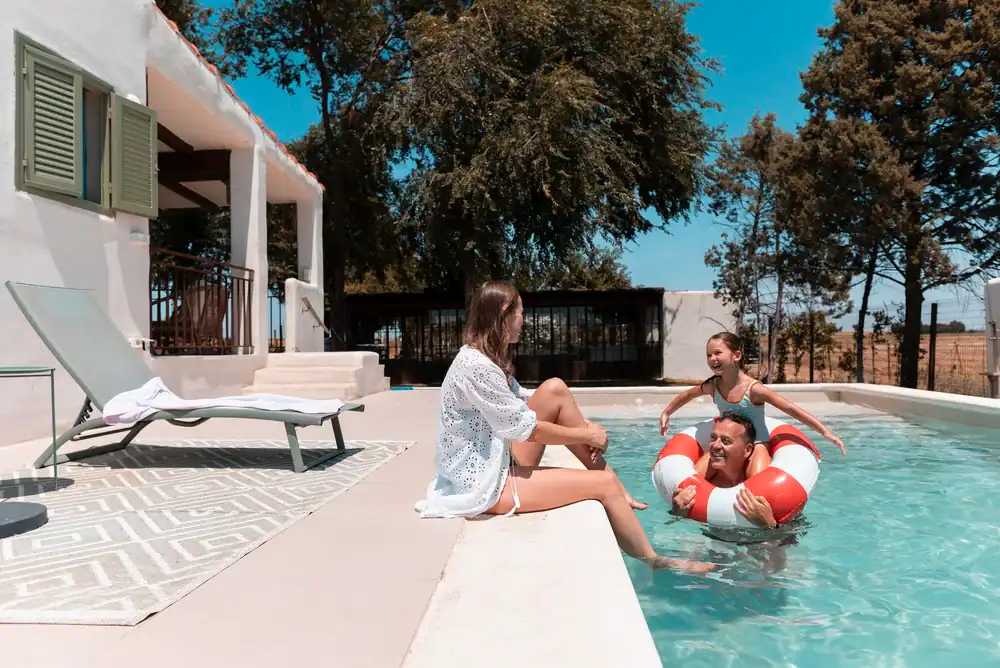

You’re not just adding a pool. You’re extending your living space, creating a place where your kids will spend entire summers, and adding real value to your property—8 to 15 percent according to the National Association of Realtors in Nassau and Suffolk County markets.
But that only happens if the job is done right. If the excavation accounts for Valley Stream’s soil conditions. If the permits clear without delays. If the construction holds up through Long Island winters and humid summers.
A well-built pool gives you a longer season—May through October with the right heating system—and fewer headaches down the road. That’s 10 to 12 extra weeks of use each year compared to an unheated pool. The difference between a pool you use and a pool you regret comes down to who builds it and how they handle the details that most homeowners never see.
We’ve been working in Valley Stream and across Nassau and Suffolk County for nearly two decades. We’re licensed, insured, and carry zero complaints with the BBB and Consumer Affairs—something you can’t say about most contractors operating on Long Island.
We’re the number one recommended certified pool installer for Leslie’s, Island Recreational, and Arthur Edwards Pools. That didn’t happen by accident. It happened because we show up, do the work right, and handle everything from excavation to final inspection without passing you off to subcontractors.
Valley Stream sits in a tricky zone for pool construction. You’ve got village codes, county regulations, and soil that doesn’t always cooperate. We’ve navigated all of it hundreds of times. You’re not our first rodeo, and that experience shows in how smoothly your project runs.
First, we assess your property. That means looking at soil conditions, grading, setback requirements, and water table levels. Valley Stream has sandy soil in some areas and clay in others—both require different approaches to excavation and drainage.
Next, we handle permits and engineering. Long Island is a patchwork of regulations. What flies in one village gets rejected in another. We know what Nassau County requires, what your local building department expects, and how to get approvals without the back-and-forth that drags timelines out for months.
Then comes excavation, plumbing, electrical, and the actual pool installation. If your property has a high water table—common near the coast—we bring in dewatering equipment. If you’ve got rocky soil or need retaining walls, we account for that in the plan and the budget. No surprises halfway through the job.
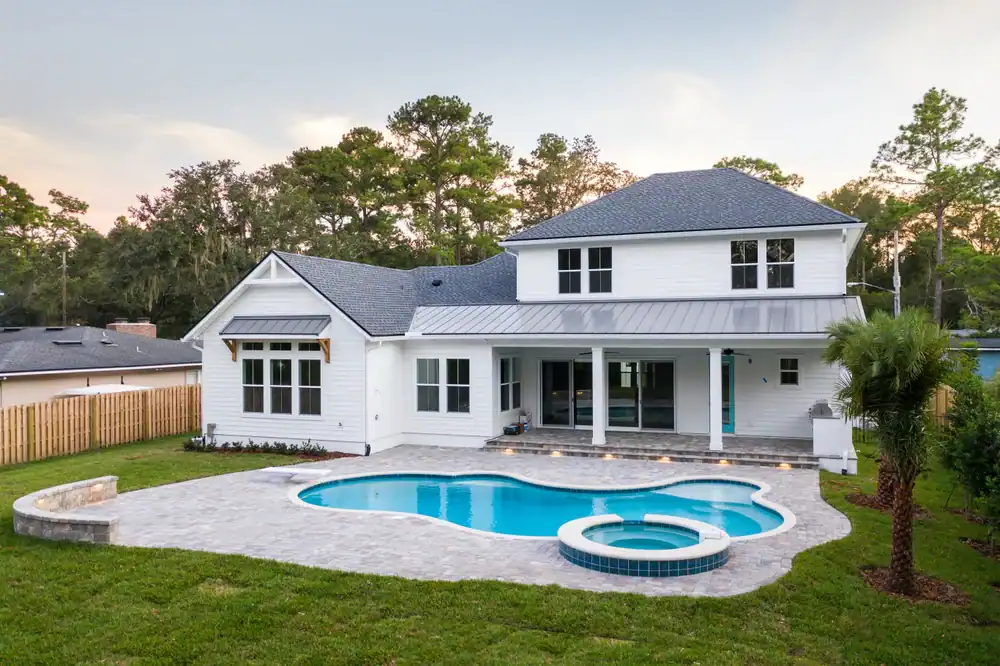
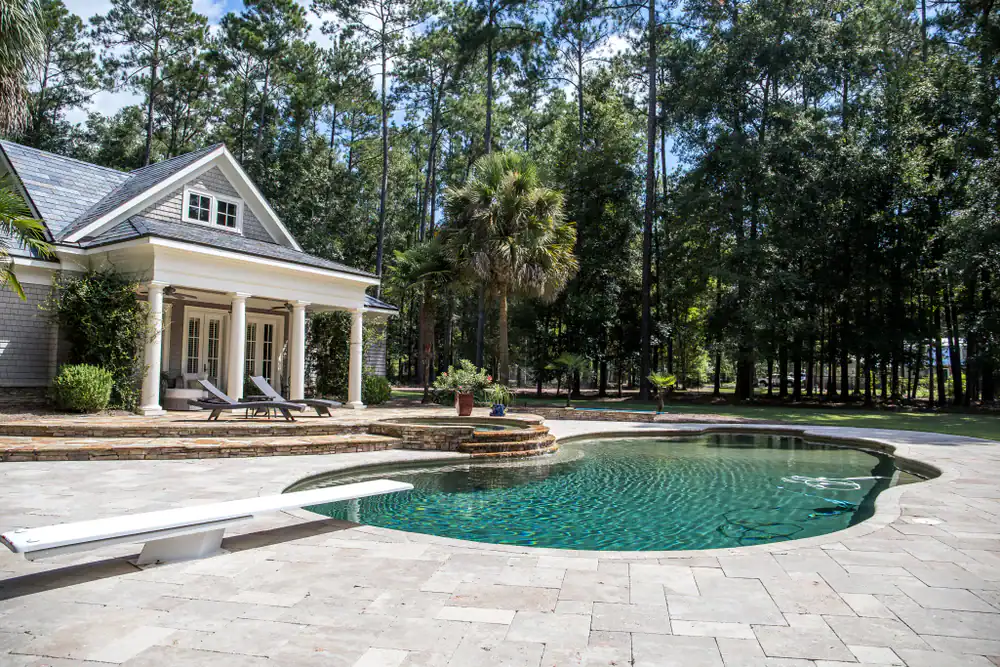
Finally, we finish with coping, tile, patio masonry, and any additional features like waterfalls, outdoor kitchens, or custom lighting. You get a complete backyard poolscape in Suffolk County or Nassau County, not a half-finished project that you’re left to coordinate on your own.
Ready to get started?
You’re getting design services, all necessary permits, professional excavation, plumbing and electrical installation, and final landscaping. We also handle pool patio masonry in Nassau County and Suffolk County—concrete surrounds, custom pool coping and tile, pavers, and any grading or retaining walls your property needs.
If you want more than just a pool, we build outdoor kitchens, BBQ areas, waterfalls, sheer descents, and diving rocks. The goal is a backyard you actually use, not just a pool surrounded by dirt and temporary fencing.
Valley Stream homeowners are increasingly looking for pools that fit contemporary lifestyles—compact geometric shapes, integrated seating, advanced lighting. We customize materials and layouts to match your property and your budget. And because we’re handling the whole project, you’re not coordinating between a pool company, a mason, an electrician, and a landscaper. One team, one timeline, one point of contact.
Long Island’s coastal weather is tough on pools. Salt air, freeze-thaw cycles, and high humidity mean your construction needs to be built for the long haul. A well-built in-ground pool lasts 25 to 30 years or more with regular maintenance. Cut corners on construction, and you’re looking at repairs within the first five years.
Most in-ground pool projects in Valley Stream take 8 to 12 weeks from permit approval to final inspection. That timeline assumes normal weather, no major surprises during excavation, and permits that clear without delays.
Permitting alone can take 4 to 6 weeks depending on your local building department and whether you need variances for setbacks or lot coverage. Nassau and Suffolk County each have their own requirements, and Valley Stream has village-specific codes on top of that.
Once permits are in hand, excavation and construction move quickly. But if your property has a high water table or rocky soil, expect to add time for dewatering or additional grading work. We give you a realistic timeline upfront based on your specific property conditions, not a generic estimate that falls apart two weeks into the job.
You’ll need a building permit from your local town or village, and in many cases, a survey, architectural drawings, and engineered plans. Nassau County also requires proof of liability insurance and, depending on your property, approval from the health department if you’re on a septic system.
Setback requirements vary by municipality. Some areas require pools to be at least 10 feet from property lines, others require 15 or 20 feet. Fence height, gate specifications, and drainage plans are also part of the permit package.
If your property is in a flood zone or has wetlands nearby, you may need additional approvals from county or state agencies. This is where most DIY permit attempts fall apart. We handle the entire permitting and engineering process so you’re not stuck resubmitting paperwork or waiting months for approvals that should’ve been straightforward.
The average cost for a custom in-ground pool in Valley Stream runs between $60,000 and $100,000 depending on size, materials, and site conditions. That includes excavation, the pool itself, basic coping and tile, and standard patio work.
Add another $10,000 to $20,000 if you want premium pavers, custom tile, waterfalls, or an outdoor kitchen. If your property has a high water table, rocky soil, or needs retaining walls, factor in another $2,500 to $5,000 for mitigation work.
Permits and engineering typically run $1,500 to $4,500 in Nassau and Suffolk County. Heating systems that extend your season from May to October add $4,000 to $8,000 depending on the type. The key is getting a detailed estimate upfront that accounts for your specific property conditions, not a lowball number that balloons once the contract is signed.
The biggest mistake is hiring based on price alone. Long Island has seen dozens of cases where homeowners paid contractors upfront, only to have the job abandoned or done so poorly it had to be rebuilt. Some projects have cost homeowners hundreds of thousands of dollars to fix.
Another common mistake is not verifying licensing and insurance. Any contractor working in Nassau or Suffolk County should have proper Consumer Affairs licensing, liability insurance, and workers’ compensation coverage. If they can’t provide proof, walk away.
Homeowners also underestimate the importance of soil analysis and permit navigation. A contractor who doesn’t assess your property’s water table, soil type, and grading before giving you a price is guessing. And a contractor who tells you permits are “no big deal” has probably never dealt with the patchwork of codes across Long Island municipalities. You want someone who’s done this hundreds of times and knows where the problems show up before they become expensive surprises.
Not year-round, but you can extend your season significantly with the right heating system. An unheated pool in Valley Stream is typically usable from late June through early September—about 10 to 12 weeks. Add a heat pump or gas heater, and you’re looking at May through October, nearly doubling your usable time.
Some homeowners with enclosed pool areas or heated indoor-outdoor setups can swim into November or even December, but that requires significant investment in enclosures and heating infrastructure. For most residential pools, the goal is maximizing the warm-weather months, not fighting Long Island winters.
Proper winterization is critical. Long Island’s freeze-thaw cycles can crack pipes, damage equipment, and cause structural issues if your pool isn’t closed correctly. We recommend professional winterization every fall and opening every spring to avoid costly repairs. A pool that’s maintained through the off-season lasts decades. One that’s neglected starts showing problems within a few years.
Concrete pools—also called gunite or shotcrete—are the most customizable. You can build any shape, any depth, and add custom features like beach entries, swim-up bars, or integrated spas. They’re also the most durable, lasting 30+ years with proper maintenance. The tradeoff is cost and construction time. Concrete pools are the most expensive and take the longest to install.
Vinyl liner pools are the most affordable upfront, but the liner needs replacement every 7 to 10 years at a cost of $4,000 to $6,000. They’re faster to install than concrete and offer some customization, but they’re more prone to tears, fading, and algae buildup along the seams.
Fiberglass pools are pre-manufactured shells that get craned into your excavated hole. Installation is fast—often just a few weeks—and the smooth surface resists algae better than concrete or vinyl. But you’re limited to the shapes and sizes the manufacturer offers, and large fiberglass pools can be difficult to transport and install on properties with tight access. For Valley Stream homeowners who want full customization and long-term durability, concrete is usually the best choice.
Other Services we provide in Valley Stream