Planning a pool in Nassau County? Costs range $35,000-$80,000+ depending on type and features. Learn what you'll actually pay beyond the base quote.
Share:
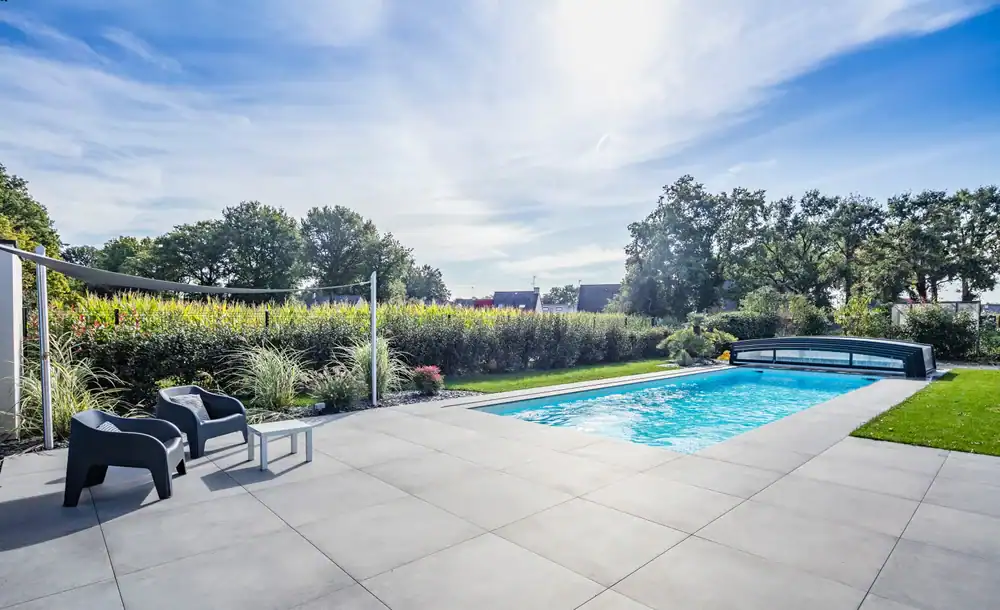
You’ve been thinking about it for months. Maybe years. That perfect summer evening, floating in your own backyard pool while the kids splash nearby. But before you dive into this major investment, you need real numbers, not marketing fluff.
Installing an in ground pool in Nassau County, NY involves more variables than most homeowners realize, and costs can swing dramatically based on decisions you make early in the process. Ground conditions here are different. Permit requirements matter. And the gap between a contractor’s initial quote and your final invoice can be jarring if you don’t know what to expect.
Here’s what you’re actually looking at for 2026, broken down without the sales pitch.
The short answer: most Nassau County, NY homeowners spend between $35,000 and $80,000 on in ground pool installation, with luxury custom builds easily topping $120,000. But here’s what matters more than that range—understanding why your project might land at the low end, the high end, or somewhere in between.
Your pool type drives the baseline cost. Vinyl liner pools start around $35,000 to $65,000 for standard installations. Fiberglass pools run $55,000 to $80,000. Concrete or gunite pools—the kind you see in high-end backyards with custom shapes and integrated features—typically start at $65,000 and climb past $120,000 depending on complexity.
Size matters, obviously. A standard 12-by-24-foot pool (288 square feet) costs significantly less than a 20-by-40-foot family pool. You’re paying $90 to $250 per square foot in Nassau County, which runs about 20-30% higher than national averages. That’s not price gouging—it’s the reality of Long Island labor costs, ground conditions, and permit requirements.
Let’s talk about what you’re actually buying with each pool type, because the material you choose affects everything from installation timeline to what you’ll spend on maintenance for the next 20 years.
Vinyl liner pools offer the lowest upfront cost for new pool construction, typically $35,000 to $65,000 installed. The pool shell is built with wall panels, then a custom-fitted vinyl liner holds the water. The surface is smooth and comfortable, and algae has a harder time taking hold compared to porous surfaces. The catch? That liner needs replacement every 7-10 years at $4,000 to $6,000 a pop. Annual maintenance runs about $1,500, and you’ll need to be careful about sharp objects that can puncture the liner. For homeowners who want a pool now without the highest upfront investment, vinyl makes sense—just budget for that future liner replacement.
Fiberglass pools land in the middle range at $55,000 to $80,000. These are pre-manufactured shells that get delivered to your property and set into the excavated hole. Installation is faster than other types—sometimes just a few weeks from start to finish. The gel-coat surface resists algae naturally, keeping your chemical costs and cleaning time lower. Maintenance averages around $1,000 per year, the lowest of the three types. The limitation is shape and size—you’re choosing from existing molds rather than custom designs. But if you find a fiberglass pool shape that works for your yard, the long-term cost efficiency is hard to beat.
Concrete or gunite pools represent the premium option, starting at $65,000 and easily exceeding $120,000 for custom designs. This is what you’re getting when you see resort-style pools with vanishing edges, integrated spas, beach entries, and custom tile work. The construction process takes longer—6 to 8 weeks or more—because the pool is literally built in place. You have complete design freedom. Any shape, any depth, any feature you can imagine. The tradeoff is higher upfront cost, longer installation time, and more intensive maintenance. The porous concrete surface requires more chemicals to prevent algae, and you’ll need resurfacing every 10-15 years. Annual maintenance typically runs $1,500 to $2,000. For homeowners who want a true custom backyard oasis and plan to stay in their home long-term, gunite delivers.
Here’s what most contractors won’t tell you upfront: none of these base prices include everything you actually need for a functioning pool. Excavation, permits, fencing, electrical work, and decking all cost extra. We’ll break those down in the next section, because that’s where budgets often explode.
This is where most homeowners get blindsided. You get a quote for $50,000, approve it, then discover you need another $15,000 to $25,000 before you can legally use your pool. Let’s walk through the costs that often aren’t included in that initial number.
Permits and inspections in Nassau County, NY run $500 to $3,000 depending on your municipality and pool size. You need approval before breaking ground, and inspections at various stages of construction. Professional pool companies handle this process, but the fees still land on your invoice. Don’t skip this step—unpermitted pools create major headaches when you try to sell your home.
Excavation costs vary wildly based on what’s underground. Standard dirt excavation runs $1,000 to $3,000. But Nassau County has rocky soil and high water tables in many areas. If your contractor hits rock or hardpan, you’re looking at $5,000 to $15,000 just to dig the hole. There’s no way to know for certain until excavation starts, which is why smart homeowners budget a 10-20% contingency for unexpected site conditions.
Fencing is mandatory under New York State law. You need a barrier at least 4-5 feet high with self-closing, self-latching gates. Depending on the material you choose—chain link, aluminum, wood, vinyl—you’ll spend $10 to $45 per linear foot. Most pools require 200-300 linear feet of fencing, putting your total at $2,000 to $13,500. This isn’t optional. It’s a legal requirement and an insurance requirement.
Electrical work for pool pumps, filters, lights, and heaters averages $2,000 to $10,000. You need a licensed electrician to run power from your home’s main panel to the pool equipment. Distance matters—the farther your pool is from your electrical panel, the more you’ll pay. Some pool contractors include basic electrical in their quote; others don’t. Ask specifically what’s covered.
Decking and coping create the finished look around your pool and provide safe walking surfaces. Basic concrete decking might add $3,000 to $10,000. Upgraded materials like pavers, natural stone, or stamped concrete can push that to $15,000 or more. Your pool needs this—it’s not decorative, it’s functional. Budget for it from the start.
Add-ons pile up fast. A diving board runs $300 to $1,000. LED lighting systems cost $450 to $1,800. Heating systems range from $500 for basic solar to $7,500 for high-end heat pumps. Waterfalls and water features start at $2,500 and climb to $25,000 for elaborate designs. Automatic pool covers run $8,000 to $15,000. None of these are necessary, but many Nassau County homeowners find them essential for the pool experience they’re envisioning.
Here’s the reality: if a contractor quotes you $50,000 for “pool installation,” your actual all-in cost will likely be $65,000 to $75,000 once you add permits, fencing, electrical, decking, and a few features. Plan for it now, not after you’ve signed a contract.
Not all pool contractors are created equal, and the difference between a qualified professional and a cut-rate operator can cost you tens of thousands in repairs, delays, and headaches. Let’s talk about what separates legitimate pool builders from companies you should avoid.
Luxury pool builders focus on custom design, premium materials, and comprehensive project management. You’re paying more upfront—often 20-40% above standard contractors—but you’re getting resort-quality results, detailed planning, and typically better warranties. These companies employ in-house designers, use top-tier subcontractors, and handle every aspect from permits to final cleanup. If you’re investing $100,000+ in a custom gunite pool with integrated spa, outdoor kitchen, and elaborate landscaping, a luxury builder makes sense. You’re buying expertise and accountability.
Standard pool contractors deliver solid installations at mid-range pricing. They work primarily with vinyl and fiberglass pools, offer some customization within template designs, and coordinate the necessary subcontractors. Most Nassau County, NY homeowners working with $40,000 to $70,000 budgets fall into this category. The key is vetting carefully—check licenses, insurance, references, and completed projects in your area. A good standard contractor delivers quality work without the luxury price tag.
Here’s what you need to ask every pool contractor before you commit to anything. These questions separate professionals from problems waiting to happen.
Start with licensing and insurance. Ask for their contractor license number and verify it with New York State. Request proof of liability insurance and workers’ compensation coverage. If someone gets hurt on your property during construction and the contractor isn’t properly insured, you’re liable. Don’t take their word for it—ask for documentation.
Get detailed, itemized quotes from at least three contractors. The quote should break down exactly what’s included: pool shell, equipment, excavation, permits, electrical, plumbing, decking, fencing. If it’s one lump sum with no detail, that’s a red flag. You can’t compare quotes if you don’t know what each one includes.
Ask about their installation timeline and what factors might delay it. Weather, permit delays, equipment availability, and subcontractor scheduling all affect when your pool is ready. A contractor who promises a specific completion date without explaining variables is either inexperienced or dishonest. You want someone who gives you a realistic timeline with contingencies built in.
Find out who’s actually doing the work. Some contractors subcontract everything—excavation, plumbing, electrical, finishing. That’s not necessarily bad, but you need to know who’s on your property and whether they’re qualified. Ask for the names of subcontractors and verify their credentials too.
Request references from recent projects in Nassau County. Talk to homeowners who had pools installed in the last 12-24 months. Ask about communication, timeline accuracy, how problems were handled, and whether there were surprise costs. Most contractors will give you their happiest customers as references, but you can still learn a lot from those conversations.
Understand the payment schedule. Never pay the full amount upfront. Standard practice is a deposit (usually 10-30%), progress payments at key milestones, and final payment upon completion and inspection. If a contractor wants 50% or more upfront, walk away. That’s a sign of cash flow problems or worse.
Ask about warranties. What’s covered, for how long, and by whom? Equipment manufacturers typically offer warranties on pumps, filters, and heaters. The contractor should warranty their installation work. Get everything in writing. Verbal promises mean nothing when something goes wrong six months after installation.
Long Island’s geology creates challenges that generic online pool cost calculators don’t account for. Understanding these local factors helps you budget realistically and avoid nasty surprises during excavation.
Nassau County, NY sits on glacial deposits that left behind rocky soil, clay layers, and variable water tables. Some properties have relatively easy digging. Others hit bedrock three feet down. There’s no way to know for certain until excavation starts, which is why experienced local contractors build contingencies into their quotes.
Rocky soil means more than just difficult digging. It often requires specialized equipment, additional labor, and more time. What should be a two-day excavation job can turn into a week-long project if your contractor hits unexpected rock. That’s why excavation costs range so widely—$1,000 to $3,000 for straightforward sites, $5,000 to $15,000 when rock becomes a major issue.
High water tables affect pool construction in several ways. If groundwater sits close to the surface, your pool needs additional engineering to prevent it from literally floating out of the ground when empty. This might require hydrostatic relief valves, additional drainage systems, or even a complete redesign of the pool’s structural approach. These aren’t optional fixes—they’re necessary to prevent catastrophic failure.
Soil testing before you commit to a contract can save you from budget disasters. For $300 to $800, a geotechnical engineer can tell you what’s underground and whether your planned pool location will create problems. If you’re investing $60,000 or more, that’s money well spent for peace of mind.
The coastal environment here also accelerates wear on pool equipment and finishes. Salt air corrodes metal components faster than inland locations. Freeze-thaw cycles during winter can damage pool surfaces and plumbing if winterization isn’t done properly. These aren’t deal-breakers, but they mean maintenance matters more in Nassau County than in other regions. Factor that into your long-term ownership costs.
Local contractors who’ve been working in Nassau and Suffolk Counties for years understand these conditions. They know which neighborhoods have difficult ground, they’ve navigated the permit process hundreds of times, and they can give you realistic expectations. That local expertise is worth paying for.
Installing an in ground pool is one of the biggest investments you’ll make in your home. The key to avoiding budget disasters and contractor nightmares is understanding that base installation quotes exclude 30-50% of essential costs. When you plan for permits, fencing, electrical, decking, and Nassau County’s unique ground challenges upfront, you make better decisions and avoid mid-project panic.
Vinyl pools offer the lowest entry point at $35,000 to $65,000 but require liner replacements every decade. Fiberglass pools balance upfront cost and long-term maintenance efficiency at $55,000 to $80,000. Custom gunite pools deliver complete design freedom starting at $65,000 and climbing past $120,000 for resort-style installations. None of these options is inherently better—the right choice depends on your budget, timeline, and how you’ll actually use the pool.
Start planning 6-12 months before you want to swim. Get detailed quotes from at least three licensed, insured contractors. Ask hard questions about what’s included and what costs extra. Budget a 10-20% contingency for unexpected site conditions. And if you’re tackling a comprehensive outdoor renovation—pool, patio, outdoor kitchen, landscaping—consider working with us at Ageless Chimney. We handle multiple services under one roof, which means you’ll get better coordination, clearer accountability, and often better pricing than hiring four separate contractors who’ve never worked together before.
Article details:
Share:
Continue learning: