Concrete vs Pavers: Which Survives Long Island Winters?

Long Island's freeze-thaw cycles destroy the wrong driveway material. Find out whether concrete or pavers can actually handle Nassau County winters without constant repairs.

Share:

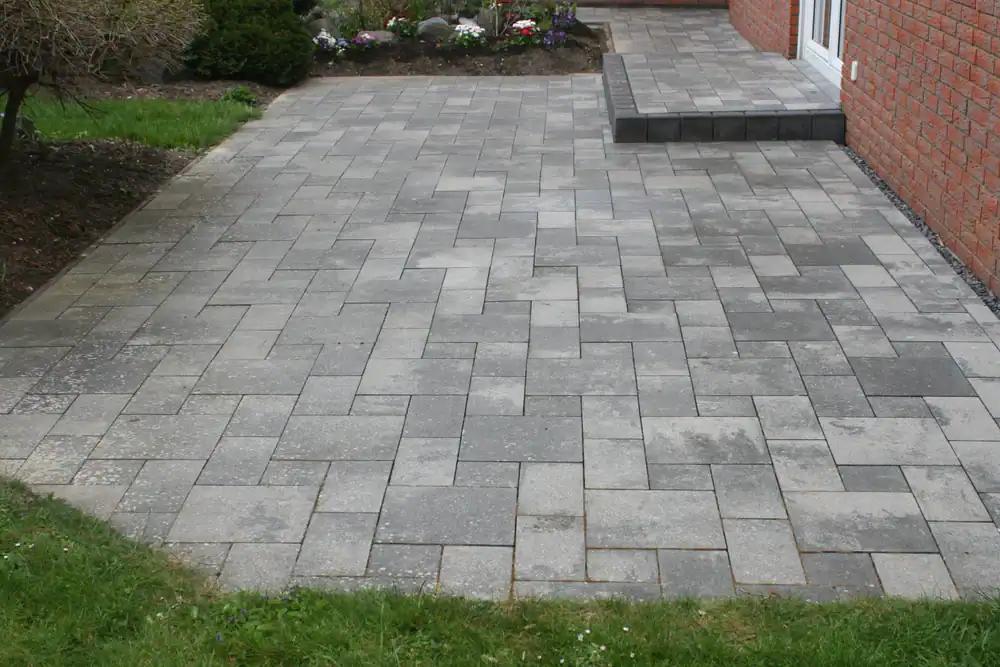
Close-up of gray patio paving stones in Nassau County, NY

You’re standing in your driveway, staring at another crack that wasn’t there last month. Or maybe you’re planning a new installation and trying to figure out which material won’t turn into a maintenance nightmare after one Long Island winter. The concrete vs pavers decision isn’t just about picking a surface—it’s about choosing something that can handle what Nassau County throws at it. Freeze-thaw cycles. Salt air. Nor’easters. Temperature swings that never let your driveway rest. This isn’t a cosmetic choice. It’s a 20-year investment, and getting it wrong means you’ll be dealing with repairs, replacements, and regret. Here’s what actually happens when these materials face Long Island winters, and what that means for your wallet.

Driveway Materials Comparison: Durability in Freeze-Thaw Climates

Quick answer

  • The real difference between concrete and pavers is how each one reacts when water gets inside and freezes.
  • Long Island winters hover between 20 and 40 degrees, so a driveway goes through freeze-thaw cycles dozens of times a season.
  • Concrete is rigid and fights that movement until it cracks. Pavers are separate units with sand-filled joints, so the surface flexes instead.

The biggest difference between concrete and pavers isn’t how they look—it’s how they respond when water gets inside them and freezes. Long Island sits in the worst possible climate zone for driveways. Temperatures don’t stay cold or stay warm. They hover between 20 and 40 degrees all winter, which means your driveway goes through freeze-thaw cycles dozens of times every season.

When water freezes, it expands by about 9%. Inside concrete, that expansion creates thousands of pounds of pressure per square inch, pushing the material apart from the inside. Concrete is rigid. It fights that movement, and eventually, it loses. Pavers work differently. They’re individual units with sand-filled joints, which means the system flexes instead of fighting. That’s not marketing talk—it’s physics.

How Concrete Handles Nassau County Winters

Quick answer

  • Concrete is one rigid slab, so water that freezes in its pores and small cracks has nowhere to go and the slab cracks.
  • Even air-entrained concrete cannot adapt to ground movement or repeated temperature swings.
  • Coastal salt air plus winter deicing salt speeds up surface scaling and spalling, and magnesium chloride deicers are especially hard on it.
  • Concrete here typically needs major work every 15 to 20 years, and skipping regular sealing can cut that short.
  • Patches never match the color or texture, and when the slope settles, water pools, finds cracks and freezes.
Small damage does not stay small on a driveway. A crack that costs $50 to fill today can become a subgrade failure needing $5,000 of removal and replacement next year. Concrete here typically needs major work every 15 to 20 years, and without sealing every three to five years you might only get 7.

Concrete driveways in Nassau County face a specific problem: they’re one large, rigid slab trying to stay intact while everything around them moves. When temperatures drop, any water that’s worked its way into microscopic cracks or pores freezes and expands. The concrete has nowhere to go, so it cracks.

Even with air-entrained concrete mix—which is designed specifically for freeze-thaw resistance—you’re still dealing with a material that can’t adapt to ground movement or repeated temperature swings. Add Long Island’s coastal salt air on top of winter deicing salt, and you’re accelerating surface scaling and spalling. Chemical deicers, especially those with magnesium chloride, eat away at the top layer of concrete over time.

Here’s what happens in practice: a small crack that costs $50 to fill today can turn into a subgrade failure requiring $5,000 in removal and replacement next year. Concrete driveways in Nassau and Suffolk Counties typically need major work every 15-20 years, and that’s with proper maintenance. Without regular sealing every 3-5 years, you might only get 7 years before serious damage appears.

The repair process is another issue. When concrete cracks, you can patch it, but the patch is always visible. The color won’t match. The texture won’t match. And if the damage is widespread, you’re looking at resurfacing at $3-7 per square foot or full replacement. Concrete drainage also depends entirely on perfect sloping. If the grade isn’t right—and it rarely stays perfect as the ground settles—water pools, finds cracks, freezes, and the cycle accelerates.

How Pavers Perform in Coastal Freeze-Thaw Conditions

Quick answer

  • Pavers accept movement and control it: each unit can shift slightly without cracking.
  • The sand-filled joints act as drainage, so less water sits on the surface waiting to freeze.
  • If one paver is damaged, you replace that piece only, with no visible patch.
  • Pavers rated for freeze-thaw climates resist salt and hold their color, and the textured surface gives better grip on ice.
  • With 8 to 10 inches of excavation, a compacted base and proper slope, pavers can last 25 to 50 years.
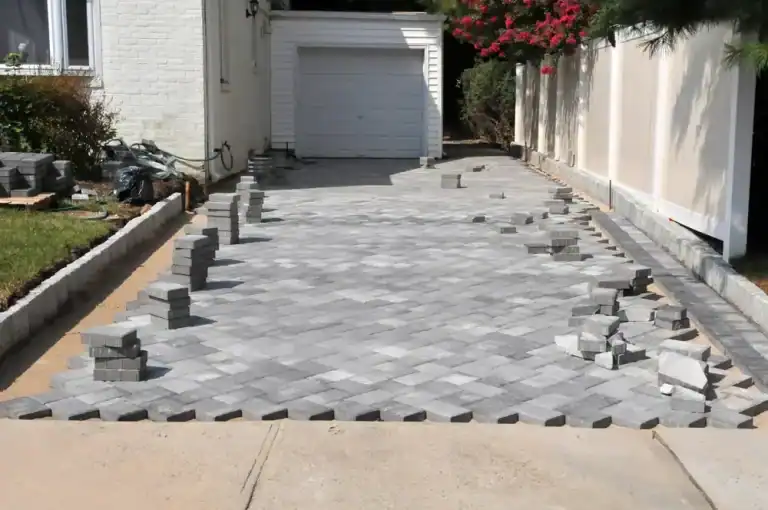
Paver driveway installation in progress in Nassau County, NY
Pavers set over 8 to 10 inches of excavation, compacted base and a proper drainage slope can last 25 to 50 years in Long Island’s freeze-thaw cycles.

Pavers start from a completely different design philosophy: accept movement and control it, rather than resist it. Instead of one large slab, you have thousands of individual units with sand-filled joints, all sitting on a carefully constructed base. When temperatures drop and the ground shifts, each paver can move slightly without cracking.

The joints between pavers aren’t a weakness—they’re a drainage system. Water moves through those gaps naturally instead of sitting on the surface looking for a way in. That reduces the amount of standing water that can freeze and cause damage. When a freeze-thaw cycle does affect a paver, you replace that one piece. Not the whole driveway. Not a visible patch. Just that unit.

Pavers also resist salt damage better than concrete, especially when you’re using high-quality concrete pavers or natural stone rated for freeze-thaw climates. Manufacturers like Cambridge, Techo-Bloc, and Unilock design pavers with compressive strengths exceeding 8,000 PSI specifically for Northeast weather patterns. They maintain color retention despite UV exposure and salt air, which matters when you’re a few miles from the ocean.

The textured surface of pavers provides better traction during icy conditions, which is a safety consideration during Long Island winters. Darker colors also absorb heat more effectively, helping snow and ice melt faster than on lighter concrete surfaces. When installed properly—with 8-10 inches of excavation for Long Island’s freeze-thaw cycles, compacted base layers, and proper drainage slope—pavers can last 25-50 years with minimal maintenance. That’s not just longer than concrete. It’s a fundamentally different lifespan category.
Coastal Climate Durability: Salt Air and Winter Damage

Quick answer

  • Nassau County driveways face salt from Atlantic air all year, not only when deicer goes down.
  • Concrete is porous, so salty moisture gets trapped inside and causes pitting, scaling and discoloration.
  • Coastal salt and winter deicer together are a two-front attack that concrete struggles with, even with regular sealing.

Nassau County isn’t just cold in winter—it’s coastal. That means you’re dealing with salt exposure year-round, not just when you’re spreading deicer. Salt air from the Atlantic accelerates deterioration in materials that aren’t designed for it, and it’s a factor that homeowners often overlook when choosing between concrete and pavers.

Concrete is porous. It absorbs moisture, and when that moisture contains salt, the salt gets trapped inside. Over time, that causes surface pitting, scaling, and discoloration. Winter deicing salt makes it worse. The combination of coastal exposure and chemical deicer application creates a two-front attack that concrete struggles to handle, even with regular sealing.

Driveway Maintenance Costs Over Time

Quick answer

  • Pavers cost more to install, but the gap narrows a lot once ten years of upkeep is counted.
  • Concrete needs sealing every 3 to 5 years, ongoing crack repairs, possible resurfacing and eventually full replacement.
  • Pavers need little more than occasional joint sand and cleaning, and a cracked or settled paver is swapped out on its own.
  • Concrete punishes a missed sealing or an ignored crack. Pavers are more forgiving and need fewer contractor visits.
Installed cost per square foot, Nassau County driveway
Concrete, plain gray to decorative$6 to $15
Pavers, by material and design$10 to $30
On a standard 600 square foot driveway that is a gap of $2,400 to $9,000 on installation day. Over ten years, once sealing every three to five years at $110 to $1,500 a time and crack repairs at $100 to $800 are counted, the gap narrows to $1,400 to $6,300, or 5 to 15 percent on a $15,000 project.

The upfront cost difference between concrete and pavers is real. Concrete runs $6-15 per square foot installed for plain gray to decorative finishes. Pavers cost $10-30 per square foot depending on material quality and design complexity. On a standard 600-square-foot driveway, that’s a difference of $2,400 to $9,000 at installation.

But that’s only chapter one. Over a 10-year period, concrete requires sealing every 3-5 years at $110-1,500 per application. Crack repairs start small but become ongoing projects, averaging $100-800 depending on severity. If you need resurfacing to refresh the appearance, that’s another $3-7 per square foot. Eventually, you’re facing full replacement, which includes removal costs on top of new installation.

Pavers need minimal maintenance by comparison. Occasional joint sand replenishment. Cleaning when needed. If a paver cracks or settles, you replace just that piece—no color mismatch, no visible repair, effectively zero cost for the hardscape disruption. When you calculate total cost of ownership over 10 years, the gap between concrete and pavers is only $1,400-6,300. On a $15,000+ project, that’s a difference of 5-15%. And at year 10, the paver surface still looks new while concrete looks tired.

The maintenance schedule matters too. Concrete demands consistent attention—seal it, patch it, monitor it. Miss a sealing cycle or ignore a crack, and you’re accelerating failure. Pavers are more forgiving. They don’t require the same level of preventative intervention, which means less time, less hassle, and fewer contractor visits over the life of the surface.

Repair Costs and Long-Term Value

Quick answer

  • When a pipe under the driveway needs work, concrete gets cut and patched, leaving a visible seam where water can get in next.
  • Pavers are lifted, set aside and put back exactly as they were, with no sign a repair happened.
  • A new driveway adds to property value, and homes with paved driveways tend to sell faster than those with gravel or a worn surface.
  • Pavers allow mixed colors, borders and curves. Stamped concrete copies the look but still cracks like regular concrete.
The driveway is also a resale number. A new one can add $10,000 to $20,000 to property value, and homes with paved driveways sell 7 to 10 days faster than those with gravel or a deteriorating surface.

Here’s a scenario that plays out constantly on Long Island: you need to access a water line or sewer pipe under your driveway. If you have concrete, the contractor cuts into the slab, fixes the pipe, pours new concrete, and you’re left with a visible patch that never quite matches. The repair disrupts the structural integrity of the slab, and that cut line often becomes the next place water infiltrates and damage starts.

If you have pavers, the contractor lifts the pavers along the repair path, stacks them to the side, fixes the pipe, re-compacts the base, and puts the exact same pavers back. Total cost for the hardscape disruption: effectively zero. No new materials. No color mismatch. No visible evidence a repair ever happened. This single scenario is why many Nassau County homeowners choose pavers even when they prefer the look of concrete—the long-term repairability makes pavers a lower-risk investment.

Resale value is another factor. A new driveway can add $10,000-20,000 to property value, and homes with paved driveways sell 7-10 days faster than those with gravel or deteriorating surfaces. In Long Island’s competitive real estate market, that timing advantage matters. Curb appeal starts at the street, and a cracked, stained driveway signals deferred maintenance to potential buyers. A well-maintained paver driveway, on the other hand, suggests quality throughout the property.

The investment isn’t just about avoiding problems—it’s about creating value. Pavers offer design flexibility that concrete can’t match. You can mix colors, create borders, build curves, and incorporate different materials within the same project. That customization enhances the overall aesthetic of your property in ways that a plain concrete slab simply doesn’t. Even decorative stamped concrete, which tries to mimic the look of pavers or stone, still cracks like regular concrete and costs nearly as much as actual pavers without delivering the same durability or repairability.

Which Material Is Right for Your Nassau County Property

The concrete vs pavers decision comes down to what you’re optimizing for. If you need the absolute lowest upfront cost and can commit to regular maintenance and eventual replacement, concrete works. But if you’re thinking about the next 20-30 years—about freeze-thaw cycles, salt exposure, repair scenarios, and total cost of ownership—pavers consistently outperform concrete in Long Island’s coastal climate.

Pavers flex with ground movement. They drain naturally. They resist salt damage. They’re repairable without visible patches. And when properly installed with the right base preparation for Nassau County conditions, they last decades longer than concrete with a fraction of the maintenance hassle. The upfront cost difference shrinks considerably when you factor in long-term value, and the peace of mind that comes from knowing your driveway can actually handle what Long Island winters throw at it is worth something too.

If you’re ready to explore which material makes sense for your specific property, we can help. With 18+ years of experience serving Long Island and expertise in masonry and hardscaping, we understand exactly what survives in this climate—and what doesn’t.

Article details:

Share: