Ashes stay dangerous longer than they look. A metal container with a lid, kept outside and well away from the building, is the whole answer.
Share:
Ashes hold heat far longer than they look like they do. A bed of gray ash with no visible glow can still contain live embers well after the fire appears to be out, and ash is a good insulator, which is exactly why the embers survive in it.
So the handling rule is built for the case where you are wrong about how cool it is.
The rule does not give a number of hours, because there is no reliable number of hours after which ash is safe in a container that burns, which is why the container is metal instead.
A few more practical notes. Keep the lid on between additions rather than only at the end. Do not stand the container on a wooden deck or against vinyl siding, both of which are extremely common on Long Island. And do not put anything else in the container, because a bucket of ash with paper in it is a bucket with fuel in it.
What ends up in the bucket depends on what went on the fire, which is the other half of this. We set out the fuel rules in what to burn in a fireplace.
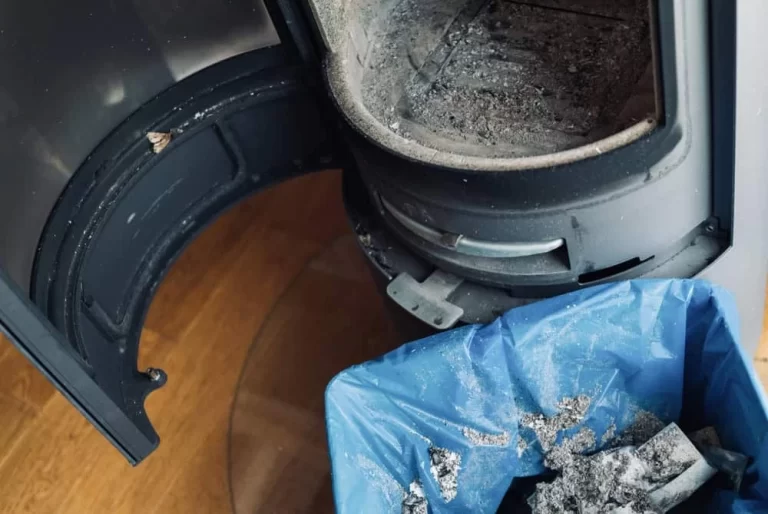
You do not have to clear the firebox out after every fire. A thin layer of ash on the floor of a masonry firebox is normal, and some people prefer it because it beds the next fire. What matters is that it does not build up to the point where it reaches the grate, restricts air under the fire, or spills out of the opening.
| What you notice | What to do |
|---|---|
| A thin layer, well below the grate | Leave it. It is doing no harm and it beds the next fire. |
| Ash up to or above the grate | Clear it. Air needs to get under the fire, and a restricted fire smokes more. |
| Ash spilling out of the firebox opening | Clear it, and keep the hearth clear of anything combustible while you do. |
| You are closing the fireplace up for the season | Clear it out. Ash holds moisture, and damp ash against cast iron and masonry does no favors over a long idle period. |
| The appliance is a stove or an insert | Follow the manufacturer’s instructions. Ash depth and clearance are specified for that unit rather than by general fireplace advice. |

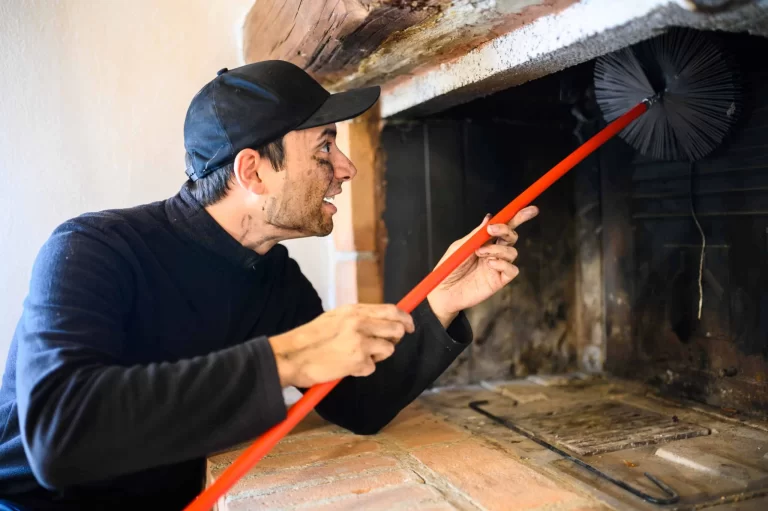
People often mix these two up. Ash in the firebox is housekeeping. Deposits on the flue walls are a different material in a different place, and they are the reason sweeping exists.
| Ash in the firebox | Creosote in the flue | |
|---|---|---|
| What it is | Mineral residue left after combustion | Condensed products of smoke that cooled on the way up |
| Where it is | The floor of the firebox, where you can see it | The flue walls, mostly where you cannot |
| Combustible | No, though it insulates live embers | Yes. This is the chimney fire risk |
| Who removes it | You, with a metal bucket and a lid | A sweep, mechanically |
So a scrupulously clean firebox tells you nothing about the flue above it. If it has been a while, a chimney cleaning and an inspection are the pair that answer the question.
Quick answer
People do use wood ash on gardens, and it is a reasonable thing to want to do with it. Two cautions, in order of importance.
First, safety: it goes in the metal container with the lid first and stays there until it is genuinely cold through. Spreading ash you are not certain about puts embers in contact with dry material and exposes them to wind.
Second, only ash from clean, untreated firewood should go anywhere near a garden. Ash from treated lumber, manufactured board, painted wood or anything with coatings on it carries whatever was in those materials. That is one more reason to burn only clean, untreated firewood.
Quick answer
That is fine. It is part of a cleaning visit. Clearing the firebox out is routine work rather than a special request.
It also gives you the chance to ask the obvious question while someone is standing there with a light: what does the flue above this actually look like. That is the part no amount of firebox housekeeping answers, and it is why the frequency question gets answered by condition rather than by a calendar. We went through that in how often a chimney should be cleaned, and the full pre-season list is in pre-winter chimney preparation.
Article details:
Share: